

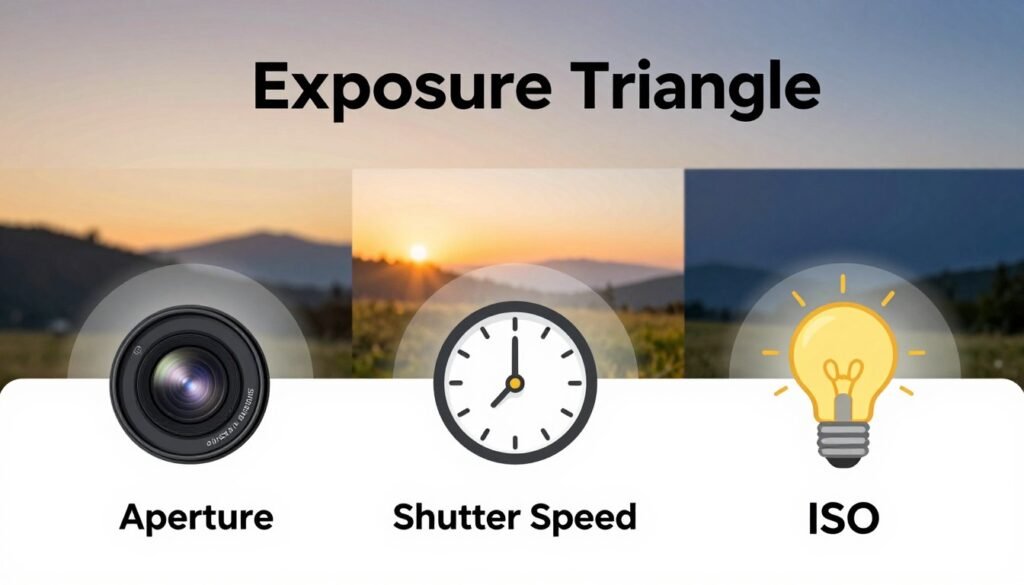
The Exposure Triangle is one of the most important concepts in photography. It refers to the relationship between three key elements: aperture, shutter speed, and ISO.
Understanding the Exposure Triangle helps you control how light enters the camera and how your final image appears. By balancing these three elements, you can achieve well-exposed and professional-looking photos.
Understand the Basic Elements of the Exposure Triangle
To master the Exposure Triangle, you need to understand how each component works and how they affect your image.
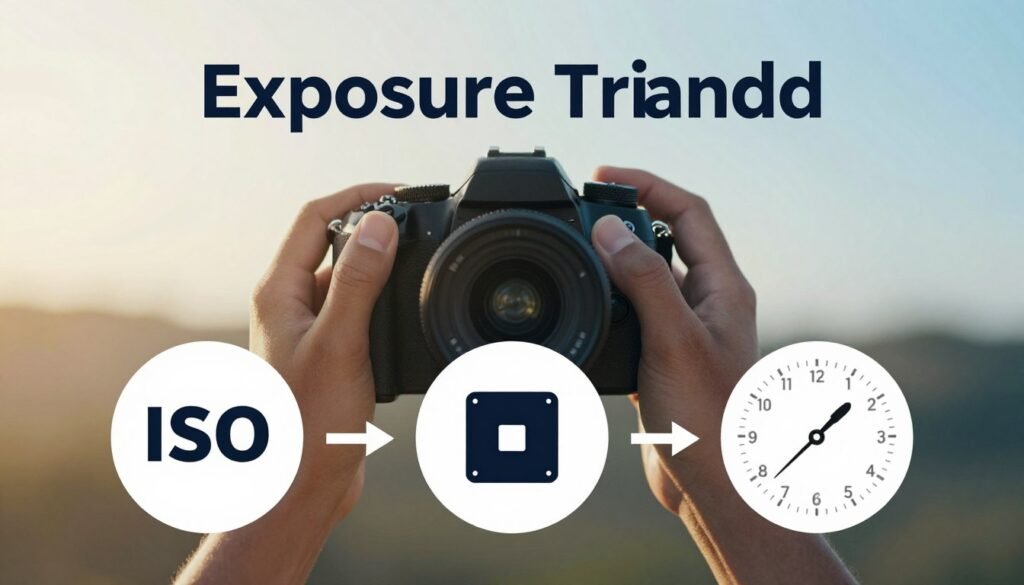
Aperture (Depth of Field Control)
Aperture controls how much light enters the lens. It also affects the depth of field, which determines how much of the image is in focus.
A wide aperture (such as f/1.8 or f/2.8) allows more light and creates a blurred background.
A narrow aperture (such as f/8 or f/11) allows less light and keeps more of the scene in focus.
Shutter Speed (Motion Control)
Shutter speed determines how long the camera sensor is exposed to light.
A fast shutter speed freezes motion, making it ideal for action shots.
A slow shutter speed captures motion blur, which can create artistic effects.
ISO (Light Sensitivity)
ISO controls the sensitivity of the camera sensor to light.
A low ISO (100–200) produces clean images with less noise.
A high ISO increases brightness but may introduce grain or noise..
How to Balance the Exposure Triangle for Correct Exposure
Balancing the Exposure Triangle is essential to achieve the right exposure.
If you increase one element, you may need to decrease another to maintain balance.
Relationship Between the Three Elements
The relationship between the elements of the Exposure Triangle is interdependent, meaning each element affects the others. Aperture controls the amount of light entering the camera, while shutter speed controls how long the sensor is exposed to light. ISO determines the sensor’s sensitivity to light.
To achieve the correct balance, you need to understand how these elements interact together. For example, in bright lighting conditions, you can use a narrow aperture, a fast shutter speed, and a low ISO.
Adjusting Settings Based on Ambient Lighting Conditions
Different lighting conditions require different adjustments in the Exposure Triangle. In bright lighting, you will use different settings compared to those used in low-light environments.
Handling Bright Light in Outdoor Photography
In strong lighting, you can use a narrow aperture (a high f-number) and a fast shutter speed to reduce the amount of light entering the camera. You can also lower the ISO to the minimum possible value to avoid overexposure.
In low-light conditions, you can use a wide aperture (a low f-number) and a slower shutter speed to increase the amount of light entering the camera. You can also raise the ISO to compensate for the lack of light, while being careful to avoid excessive noise.
By following these guidelines, you can improve your photography skills and capture high-quality images in different lighting conditions.
Conclusion
Understanding the Exposure Triangle is very important in photography. It requires knowledge of the three key elements: aperture, shutter speed, and ISO sensitivity. These elements allow you to control the exposure of your images.
The Exposure Triangle is not just three separate settings; it is a group of interconnected elements that work together to achieve the ideal result. If one of these elements changes, it will affect the others.
Photography is an art that requires practice. The more you understand and apply the Exposure Triangle, the more your skills will improve. You will be able to capture professional images that express your vision.
In the end, mastering the Exposure Triangle enhances your photography skills and opens new opportunities for creativity and expression.
التعليقات الأخيرة